What Is AI Resume Screening, How Does It Work?
AI Resume Screening uses artificial intelligence to help recruiters review resumes, identify relevant qualifications, compare candidate profiles with job requirements, and organize applications for further evaluation.
Traditional screening often requires recruiters to open resumes individually and check qualifications, experience, skills, and employment history. When hundreds of applications arrive for one position, this process can consume considerable time.
AI-assisted systems can help process that information more quickly. Depending on the software, they may identify skills, extract information, compare candidate profiles with job criteria, or recommend applicants for further review.
However, there is an important distinction: AI can help identify suitable candidates, but a high ranking does not automatically mean someone is the best person for the job.
How Does the Screening Process Work?

Resume collection
Applications enter the company's applicant tracking system (ATS).

Information extraction
Software needs details like work experience, qualifications, & skills.

Job matching
The system compares extracted information with the role's requirements.

Candidate prioritization
Depending on the system, applications may be organized or ranked for recruiter review.

Human evaluation
Recruiters assess relevant experience, achievements, context, and role fit before making hiring decisions.

Interview Selection
Recruiters shortlist qualified candidates and move them forward to interviews or assessments.
The exact process varies by platform. Not every ATS uses AI, and not every AI-enabled system automatically rejects applications.
Why Is AI Changing Recruitment in 2027?
Recruitment teams face a familiar problem: finding the right person while managing application volumes, hiring deadlines, and candidate expectations.
AI is attracting attention because it can support repetitive tasks and help recruiters spend more time evaluating candidates and building relationships. The important question is whether companies can achieve these benefits without sacrificing accuracy or fairness.
According to Deloitte India's 2026 campus talent research, 86% of surveyed organizations reported that AI or agentic AI was transforming recruitment processes, while 72% reported using AI for resume screening. These findings indicate growing adoption in the research covered; they should not be treated as universal figures for every employer.
Recruitment Trends Worth Watching
1. Skills are becoming more important. Employers want to understand what candidates can actually do, not just where they studied or worked.
2. Recruiters are using automation for repetitive tasks. Resume parsing, candidate search, and application organization can reduce manual effort.
3. Human judgment still matters. Context, communication, motivation, and potential are not always clear from resume data alone.
4. Fairness and accountability are receiving more attention. Employers need to understand how their systems evaluate candidates and whether qualified people are being overlooked.
What Do the Latest AI Hiring Statistics Tell Us?
The following findings help explain why recruitment teams are exploring AI and why careful implementation matters.
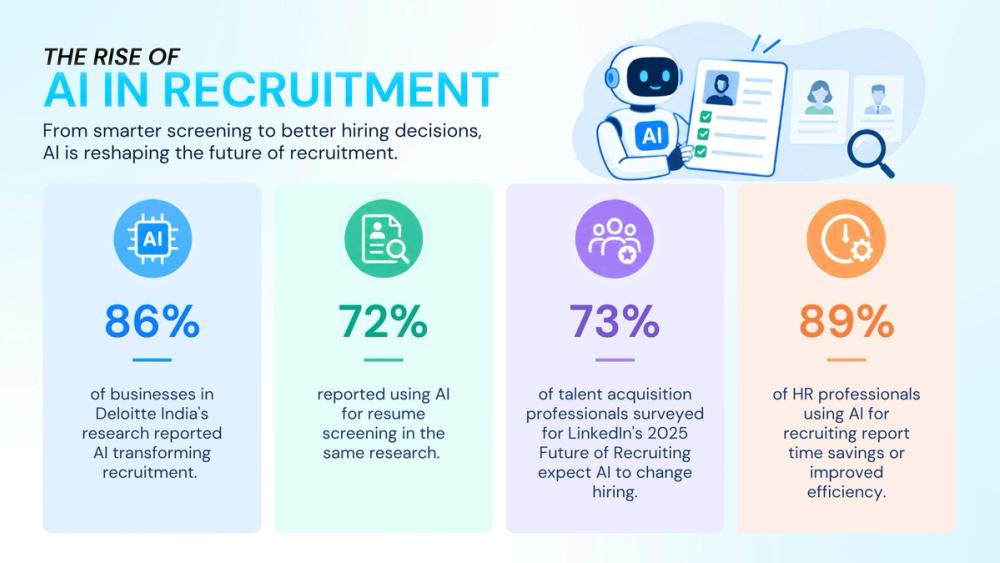
Note: These figures come from different studies, populations, and survey periods. They should not be combined into a single industry-wide adoption rate.
Sources: Deloitte India, LinkedIn, & SHRM.
What Are the Biggest Benefits of AI Resume Screening?
Explore the following three practical benefits for recruitment teams.
1. Faster Application Review
When a vacancy attracts hundreds of applications, manually checking every resume can slow down the process. AI-supported screening can help organize applications and identify profiles that meet defined requirements.
This gives recruiters more time to review relevant candidates, coordinate interviews, and communicate with applicants. Actual time savings depend on application volume, system quality, and workflow design.
2. Better Visibility Into Candidate Skills
A candidate's strongest abilities may not appear under the exact job title an employer expects. A well-configured system can help identify relevant skills across different roles, projects, and experience descriptions.
For example, a candidate who has managed interview scheduling, maintained candidate pipelines, and coordinated hiring managers may have relevant recruitment coordination skills even if their previous title was different.
3. More Consistent Initial Screening
Clear job criteria can help recruiters assess applications against the same baseline requirements. This can make early screening more structured, provided the criteria are job-related and the system is properly monitored.
AI does not guarantee unbiased results. Poor criteria, incomplete data, or flawed system design can still disadvantage qualified candidates.

What Are the Risks of Using AI to Screen Resumes?
Speed is valuable, but a faster process is not necessarily a better hiring process.
AI systems can reproduce patterns in historical hiring data, misunderstand context, or give too much importance to specific terms. A candidate with transferable skills may be overlooked simply because their resume describes those skills differently.
The U.S. Equal Employment Opportunity Commission's guidance on AI and employment explains that existing employment discrimination laws can apply when employers use automated systems in hiring.
Recruiters should pay attention to these risks:
- Unfair screening: Criteria or system behavior may disadvantage certain groups.
- Keyword dependence: Relevant experience may be missed when wording differs from the job description.
- Accessibility concerns: Some assessments may create barriers for people with disabilities.
- Limited transparency: Recruiters may struggle to explain why an application received a particular score.
- Data privacy: Candidate information must be handled according to applicable privacy and employment requirements.
The solution is not necessarily to abandon automation. It is to validate the system, monitor outcomes, provide appropriate accommodations, and retain meaningful human oversight.
How Can Recruiters Use a Resume Screening Tool Effectively?
Selecting a resume screening tool is only the beginning. Recruiters also need clear criteria, reliable processes, and regular checks to ensure the software supports good hiring decisions.
Here are five practical steps:
1. Define the role before screening. Identify essential skills, qualifications, responsibilities, and relevant experience. Avoid adding requirements that are not genuinely necessary.
2. Use job-related criteria. Evaluate candidates against the actual needs of the role instead of relying on arbitrary keyword counts or unrelated profile details.
3. Test the system with realistic resumes. Check how it handles different resume formats, career breaks, transferable skills, and equivalent qualifications.
4. Keep humans involved in important decisions. Use automated recommendations to support recruiter judgment rather than treating scores as unquestionable answers.
5. Monitor outcomes regularly. Review screening accuracy, candidate progression, false exclusions, accessibility, and potential differences in outcomes across groups.
For TekWissen, this approach connects recruitment technology with a wider objective: helping employers build effective hiring processes while keeping candidate quality and experience in focus.
AI Screening vs. Traditional Resume Screening: What's the Difference?
| Factor | Traditional screening | AI-assisted screening |
| initial review | Recruiters review applications manually. | Software can extract and organize application information. |
| Processing volume | Large volumes may require substantial manual effort. | Automation can support higher-volume processing. |
| Consistency | Depends on recruiter guidelines and execution. | Can apply configured criteria consistently, but system errors remain possible. |
| Contextual judgment | Recruiters can interpret individual circumstances. | Context may be missed or misunderstood. |
| Human involvement | Direct throughout the initial review. | Depends on workflow design and the level of automation. |
Neither approach is automatically superior in every situation. The right choice depends on hiring volume, role complexity, system reliability, and the employer's ability to maintain fair and effective oversight.
How Can Job Seekers Make Their Resumes More AI-Friendly?
Candidates do not need to fill their resumes with every keyword they find. They need to communicate their actual experience clearly.
Use these practical tips before applying:

Read the job description carefully
Identify the essential skills and responsibilities.

Use accurate, relevant terminology
Include industry terms that genuinely describe your experience.

Show measurable achievements
Explain what you did and what changed because of your work.

Choose a readable format
Use clear headings, straightforward layouts, and consistent formatting.

Avoid unsupported claims
Never add skills, qualifications, or experience you do not have.

Tailor your resume to the role
Highlight the experience most relevant to the opportunity.
For example, instead of writing “Responsible for recruitment activities” a recruiter might write: “Coordinated candidate screening and interview scheduling while maintaining communication with hiring managers.”

How Is AI Changing the Recruiter's Role?
As automation takes over parts of application processing, recruiters can focus more attention on tasks that require human interaction and judgment.
That includes understanding a hiring manager's expectations, assessing transferable skills, discussing career goals, and helping candidates understand the opportunity.
The recruiter's value is not simply in finding a matching resume. It is in recognizing the right person for the right role.
TekWissen can position this shift as an opportunity to combine recruitment expertise with responsible technology adoption. The objective should be a more informed hiring process, not automation for its own sake.
Build a Smarter Recruitment Strategy
Conclusion
Can AI Help Recruiters Find Better Talent?
AI is changing how recruitment teams organize applications, identify relevant qualifications, and prioritize candidates for review. Yet technology alone cannot guarantee a successful hire. Clear job criteria, reliable screening processes, fair evaluation, and human judgment remain essential.
As hiring practices continue to evolve in 2027, employers should focus on using AI where it adds measurable value while checking for errors, bias, and poor candidate experiences.
At TekWissen, the opportunity is to bring recruitment expertise and technology together to help organizations make more informed talent decisions. The future of hiring is not about choosing between people and AI. It is about using technology to help people make better hiring decisions.
Frequently Asked Questions
Related Blogs

Open Roles Piling Up? Can RPO Fix Recruitment Challenges?

What Makes a Resume Stand Out in 2027? Expert ATS Resume Tips for Job Seekers

Job Search Tips That Turn Applications Into Recruiter Callbacks
What Are Ghost Jobs? How to Spot Real Job Opportunities

Reimagining Talent Acquisition: RPO in the Future Workforce Ecosystem

Why Recruitment Process Outsourcing Is Dominating Hiring Strategies in 2026 and Beyond