Why Is Gen Z Changing the Way Companies Hire?
Hiring expectations are no longer the same as they were a few years ago. Today's younger workforce is more digitally connected, career-focused, and selective about where they want to work. They often look beyond salary and consider workplace culture, learning opportunities, flexibility, and long-term career development.
For employers, this creates a new challenge. Finding candidates is one thing, but attracting the right talent and keeping them interested throughout recruitment is another.
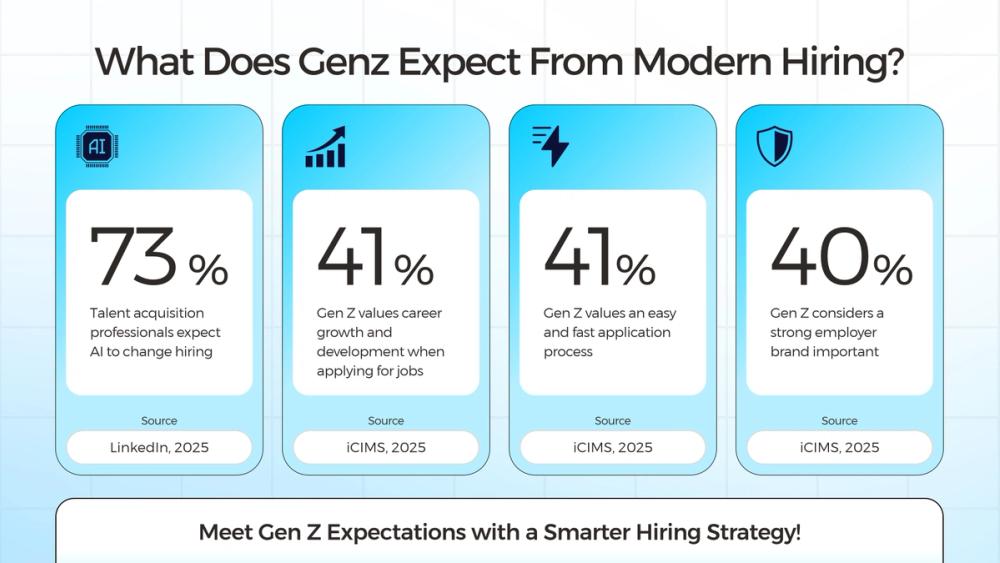
According to iCIMS' 2025 research, 41% of Gen Z respondents consider career growth and development important when applying for a job. Another 41% value an easy and fast application process, while 40% consider a strong employer brand important.
Reference PDF:
https://www.icims.com/wp-content/uploads/2025/05/2025_Insights_May_US_FINAL2.pdf
These findings show that companies need to rethink how they approach recruitment.
Here are some important expectations shaping the next generation of hiring:

Faster hiring
Candidates expect a simple application process and timely updates.

Career development
They want opportunities to learn new skills and grow professionally

Digital experience
They prefer convenient, technology-enabled interactions.

Workplace flexibility
Remote and flexible working options can influence their job decisions.

Transparent communication
Clear information about roles, salaries, and hiring stages helps build trust.

Work Culture
Inclusive workplaces that respect their ideas offers equal growth opportunities.
The challenge for employers is bringing all these expectations together without making recruitment more complicated. This is where RPO partnerships can make a difference.
What Is Driving the Future of RPO?
Recruitment Process Outsourcing (RPO) is a hiring solution where an external recruitment partner manages some or all of a company's recruitment activities. It can cover candidate sourcing, screening, interview coordination, recruitment technology, and hiring support.
However, the role of RPO is expanding. Businesses are no longer looking only for recruitment support. They want better workforce planning, access to skilled talent, improved hiring experiences, and measurable recruitment results.
Several changes are shaping this shift.
1. AI Is Becoming a Part of Recruitment
Recruiters often spend considerable time reviewing resumes, searching for candidates, scheduling interviews, and managing applications. AI-powered recruitment tools can help reduce repetitive work and allow hiring teams to focus more on candidate evaluation and engagement.
According to LinkedIn's 2025 Future of Recruiting report, 73% of talent acquisition professionals agree that AI will change the way organizations hire.
AI can support recruitment through:
- Automated resume screening and candidate matching.
- Faster identification of relevant skills.
- Interview scheduling and candidate communication.
- Recruitment data analysis and reporting.
- Better talent sourcing across different platforms.
However, technology should support human decision-making rather than replace it. Recruiters still need to evaluate candidates fairly, understand their experience, and make informed hiring decisions.
2. Candidate Experience Is Becoming a Priority
Imagine applying for a job and receiving no update for several weeks. Even if the position is attractive, the lack of communication can make you lose interest.
This is a common recruitment challenge. A complicated application process, delayed responses, and unclear interview stages can affect how candidates view an employer.
A well-managed RPO partnership can help businesses improve communication at every stage. From the first application to the final offer, candidates should know what to expect and where they stand.
A better candidate experience is not just about attracting applicants. It is about giving the right candidates a reason to stay interested.
3. Skills-Based Hiring Is Gaining Attention
Traditional recruitment often gives significant importance to educational qualifications, job titles, and years of experience. However, businesses are increasingly looking at what candidates can actually do.
For example, a candidate may not have an impressive job title but could have the technical skills and practical experience required for a position.
RPO teams can help organizations identify candidates based on:
- Technical and industry-specific skills.
- Problem-solving and communication abilities.
- Relevant certifications and practical experience.
- Adaptability and willingness to learn.
- Potential for future career development.
This approach can help employers reach a wider talent pool instead of limiting their search to candidates with similar career backgrounds.
4. Flexible Recruitment Models Are Becoming Important
Hiring requirements can change depending on business growth, seasonal demand, new projects, and market conditions.
Some organizations need continuous recruitment support, while others require additional hiring resources for a specific project or location.
Modern RPO partnerships can support different requirements through:
- End-to-end recruitment: Managing the complete hiring cycle.
- Project-based recruitment: Supporting large or short-term hiring requirements.
- On-demand recruitment: Providing additional recruitment resources when needed.
- Hybrid recruitment: Combining internal recruitment teams with external expertise.
This flexibility allows businesses to adjust recruitment support according to their actual hiring needs.

How Can the RPO Hiring Process Attract Gen Z Talent?
Attracting younger candidates requires more than publishing job advertisements. Employers need a recruitment approach that is easy to understand, responsive, and aligned with candidate expectations.
A well-structured rpo hiring process can help organizations improve the candidate journey while maintaining recruitment quality.
Here is how it can work:

Hiring Requirements
The recruitment team works with the business to understand job responsibilities, required skills, experience, location, and hiring timelines.

Identify the Right Talent Pool
Recruiters search across job portals, professional networks, talent databases, and other relevant sourcing channels to identify suitable candidates.

Evaluate Candidates
Applications are reviewed against job requirements. and initial screening, while recruiters evaluate relevant experience, skills, and suitability.

Coordinate Interviews
The recruitment team manages interview schedules, shares updates, and communicates with candidates throughout the selection process.

Manage Onboarding
Once a candidate is selected, recruiters support offer communication, documentation, and onboarding coordination.

Measure Performance
Recruitment results are reviewed using metrics such as time-to-hire, cost-per-hire, candidate experience, and quality of hire.
The goal is to make each stage easier for both employers and candidates.
What Are the Key Trends Shaping RPO in 2026 and Beyond?
Recruitment is moving towards a more connected, technology-enabled, and data-driven approach. Employers need to understand these changes before deciding how to improve their hiring strategies.
Here are four important trends worth watching.
| RPO trend | What it means for businesses | |
| AI-powered recruitment | Faster sourcing, screening, and recruitment administration. | |
| Skills-based hiring | Greater focus on practical skills rather than qualifications alone. | |
| Data-driven recruitment | Better visibility into hiring performance and workforce requirements. | |
| Candidate-focused hiring | More transparent communication and smoother application experiences. |
Key Recruitment Statistics to Watch
The following findings highlight why businesses need to rethink their recruitment strategies.
How Can Businesses Prepare for the Future of RPO?
Understanding recruitment trends is only the first step. Businesses also need to put the right strategies in place to attract and retain skilled professionals.
Here are some practical ways to prepare.

Improve Your Employer Brand
Candidates often research companies before applying. Keep your career pages updated, share employee experiences, and communicate what makes your organization a good place to work.

Make Applications Easier
Avoid lengthy application forms and unnecessary steps. Make sure candidates can apply through mobile-friendly platforms and receive confirmation after submitting their applications.

Recruitment Technology
Invest in suitable ATS platforms, candidate relationship management tools, and AI-enabled recruitment solutions. However, maintain human involvement in important hiring decisions.

Candidate Communication
Keep candidates informed about application progress, interview schedules, and selection decisions. Even when there is no immediate update, timely communication helps maintain trust.

Partner Recruitment Experts
Working with an experienced RPO provider can help businesses improve sourcing strategies, manage hiring requirements, and gain access to recruitment expertise.

Track Recruitment Metrics
Do not measure recruitment success only by the number of positions filled. Also consider candidate experience, quality of hire, retention, and overall hiring efficiency.
Quick Insight: What Should Modern Recruitment Focus On?
| Traditional recruitment focus | Future-focused recruitment |
| Filling open positions | Building long-term talent pipelines |
| Resume-based screening | Skills and capability-based evaluation |
| Manual recruitment activities | Technology-supported hiring |
| Limited candidate updates | Consistent candidate communication |
| Short-term hiring targets | Long-term workforce planning |
The difference is clear: recruitment needs to become more strategic rather than simply focusing on filling vacancies.
How Does Outsourcing RPO Help Businesses Stay Competitive?
Managing recruitment internally can become challenging when businesses expand into new markets, hire for multiple positions, or struggle to find specialized talent.
This is where outsourcing rpo can provide additional recruitment support. Instead of managing every hiring activity internally, organizations can work with an external recruitment partner that understands their workforce requirements.
Some important benefits include:
- Access to wider talent networks: Connect with candidates across different industries, locations, and skill areas.
- Reduced recruitment workload: Delegate sourcing, screening, interview coordination, and other hiring activities.
- Flexible hiring support: Adjust recruitment resources based on changing business requirements.
- Better recruitment visibility: Monitor hiring performance through reports and measurable recruitment metrics.
- Consistent recruitment support: Maintain structured hiring activities across different departments and locations.
For example, a growing technology company planning to hire 100 professionals across multiple locations may struggle to manage sourcing, screening, and interviews with a small internal recruitment team.
An RPO partner can provide dedicated recruitment resources, coordinate hiring activities, and help the company manage its hiring targets more effectively.
However, outsourcing does not automatically guarantee better results. Businesses should choose a partner based on industry experience, recruitment capabilities, technology, communication, and measurable performance.
How Is TekWissen Helping Businesses Move Towards Smarter Recruitment?
Finding the right talent is becoming more challenging as workforce expectations and business requirements continue to change. Organizations need recruitment strategies that balance hiring speed, candidate quality, and long-term workforce goals.
We supports businesses through recruitment and workforce solutions designed to address different hiring requirements.
With a focus on talent acquisition and recruitment support, we help organizations connect with relevant professionals while managing their evolving workforce needs.
Whether a business is looking to strengthen its recruitment operations, access skilled talent, or manage large-scale hiring requirements, having the right recruitment partner can make the process more organized and efficient.
The focus should not simply be on filling positions. It should be on building a workforce that supports business growth.
Hire Smarter, Faster, and Better with the Right RPO Partner.
Conclusion
The expectations of the workforce are changing, and businesses cannot depend on traditional recruitment methods alone to attract the next generation of professionals. Faster hiring, better communication, career development, and technology-enabled experiences are becoming important parts of modern recruitment.
The Future of RPO will depend on how effectively businesses combine recruitment expertise, technology, and a candidate-first approach. Organizations that adapt to these changes can build stronger talent pipelines and create better hiring experiences.
At TekWissen, we understand that successful recruitment goes beyond filling open positions. It is about connecting businesses with the right talent through effective workforce and recruitment solutions. As hiring expectations continue to evolve, having the right recruitment partner can help your organization stay prepared for what comes next.
Ready to build a smarter hiring strategy? Connect with TekWissen to explore recruitment solutions that support your business growth.
Frequently Asked Questions
Related Blogs

Open Roles Piling Up? Can RPO Fix Recruitment Challenges?

What Makes a Resume Stand Out in 2027? Expert ATS Resume Tips for Job Seekers
Job Search Tips That Turn Applications Into Recruiter Callbacks
Is AI Resume Screening Changing How Recruiters Find Talent in 2027?
Are Ghost Jobs Wasting Your Time? How Can You Spot Them Before Applying?

Why Recruitment Process Outsourcing Is Dominating Hiring Strategies in 2026 and Beyond